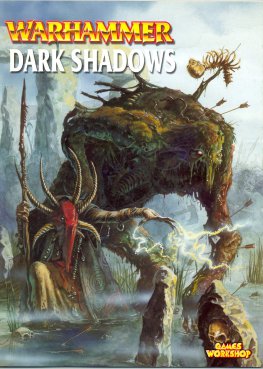
Retro Feature: Warhammer Dark Shadows

Dark Shadows Over Albion

Today we will take another walk down memory lane. Let us take a look at Dark Shadows, a campaign that ran for Wahammer Fantasy Battles during its 6th Edition. The primary focus of Dark Shadows is the rain-lashed isle of Albion. Albion up to this point in the history of the game had been a semi-mythical isle that sat in the sea beyond Brettonia, its location being analogous to the British Isles and much of the additional material found in the supplement is based pre-invasion Roman perspectives of Britain.

dark shadows

Continue reading “Retro Feature: Warhammer Dark Shadows”

Mordheim Miniatures: Witch Hunters

Witch Hunters and Warrior Priests

For those of you unfamiliar with Mordheim, let me enlighten you. Mordheim is an out-of-print skirmish game by Games Workshop. It is set in the Warhammer Fantasy setting in a ruined city called Mordheim. The city was destroyed when a  two tailed comet crashed into it for the perceived immoral behaviour of its citizens. Those not killed in the initial impact either fled or died a most terrible death during the time that followed. The city became overrun with monsters and heretics seeking the valuable wyrdstones that the comet was made from. For those regulars out there, this article on witch hunters will be similar to my previous budget builds guide and contain links where relevant.

The game was very popular but got stomped like all other specialist games by Games Workshop and now holds what can only be considered a strong cult following. Mordheim still has a very active player base that are constantly coming up with new ways to enjoy this classic, from new warbands to inventive novel scenarios.

However, without official support, sourcing all the models can be a pain, especially if you aren’t into your wargames as much as I am. This guide aims to gather together a collection of miniatures for each of the models in the Witch Hunter warband list, hopefully in an effort to save budding young witch hunters the effort of having to trawl the internet themselves trying to find obscure bits and pieces.

Continue reading “Mordheim Miniatures: Witch Hunters”

Resource: GURPS Space Navy Careers

Here are a few quick builds and lenses to help you quickly create a naval character for a sci-fi space opera setting. The reason posts have been a bit light recently is because of the Salute wargaming convention this weekend so I’ve been preparing for that. Will post more soon. I hope you find these useful to your game; like anything for GURPS they can be used to make PCs and NPCs. Game on.

cover_lg

Continue reading “Resource: GURPS Space Navy Careers”

Resource: GURPS Ship, Acheron Class

Dear all gamers and germs. So I run a GURPS campaign on and off using a homebrew universe. One of the campaigns set in this world was the crew of the Leviathan. A band of mercenaries and smugglers aboard an Acheron class ship. The ship is small and reasonably fast with good ship-to-ship attacks. I know that to anyone who plays a GURPS sci-fi game that making ships can be a massive pain so I thought I’d start sharing some of my groups efforts here. Below is all the statistics you need to be able to use an Acheron class in your GURPS games, enjoy.
Ship Class: Acheron
Tonnage: 3000t
Streamlined: Yes

Continue reading “Resource: GURPS Ship, Acheron Class”

Concerning Conversions

A ‘Conversion’ refers to a very specific type of miniature project. There’s no hard and fast rule on how to define this but I’ll do my best. Basically, when a model is converted it means that the modeller has taken pieces from elsewhere, often other kits and added them to a model in order to make it unique. It’s an incredibly fun past time of mine and I’d probably say it’s my favourite part about wargaming in general. Making unique characters and units is very fun. It’s very similar to scratch building a model but not as extreme.

A few of my most beloved miniatures are converted ones and I’d just like to talk about things that are important should you really want to customise your own figures to the max. First of all, save everything. Even the sprues if you can. You never know when you may need that pelt pouch that came with your 40k orks you bought when you were fifteen. This is of course not very space friendly and sprues quickly end up being more effort than they are worth. Instead however, you may want to keep what collectors refer to as a ‘bitz box’. Put in a bit of time and cut off all the spare parts from your sprues and store them in a box (or in my case multiple boxes). I use the plastic boxes that come with takeaway food. It might be a good idea for you, if you have a particular large amount of spare parts to organise them into categories like weapons, sci-fi/fantasy, torsos, etc.

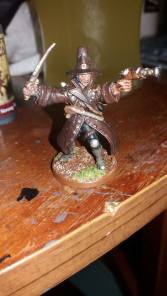
I think it’s also worth talking about non-component related things you should keep a stock of if you like adapting your own minis. The top thing of this is putty; Milliput and Green Stuff. That stuff is a  godsend allowing you to fashion parts for things you don’t usually have. Green Stuff is usually better as Milliput is very brittle, making extremely fine detail things impossible. However, Green Stuff is significantly more expensive but is generally how most miniatures that you own start out as before being turned into moulds for plastic and metal. Both are two part epoxies that generally don’t have a shelf life, buy some today, finish using it in five years’ time. To the right here is a picture of a model I converted, something I added a little bit more character to. It was originally a ‘high inquisitor’ miniature produced for D&D 3.5. However, with the exorbitant prices Games Workshop was asking for their Witch Hunter model, which frankly I don’t like very much, I decided I would adapt this guy into something more lore friendly and characterful of the Old World. I started by highliting the trims with gold and washing the model in a dark army painter tone. I then used Milliput to increase the height of the hat to make it look more like the witch hunters of Warhammer.12919474_1311326088882961_1062426483_o 12921967_1311326108882959_104305521_oI decided I didn’t like the torch and cut it off, replacing it with a pistol I fashioned from the head of a great-ax from the orc sprues that Mantic produce. I added a second pistol to his belt because a witch hunter surelyneed a brace of them not just one. I then read that Witch Hunters often cover themselves in weapons due to the danger of their work. As a result of this, I added two thin swords to his back. After painting his boots rather than keeping them black and colouring the hat extension I had something I was happy with. It was very easy and made the mini stand out in a much more lore-friendly and distinctive way.
Continue reading “Concerning Conversions”

Concerning Ravenloft

So the new Ravenloft-based adventure Curse of Strahd for Dungeons and Dragons is set for release in just over a week release next week so I thought it might be a good time to look back over at the original Ravenloft module by Laura and Tracy Hickman. I am fortunate enough to have partner that tracked down a copy of the module and I received it as a Christmas present a few years ago. Hopefully this post will help explain to people a bit of the history of Ravenloft and how it fits into the bigger D&D picture. Beneath is a scan of my copy’s cover page.ravenloft

We can see that on the cover is Strahd, the vampire lord that features prominently in the upcoming module for 5th edition. He’s a Dracula type figure that has a tortured past and that was one of the things that made Ravenloft different. Previous to the publication of the module enemies and NPCs were simply in the game to give the players something to kill or to talk to. The Hickmans changed this; they made the villain the centre of the story. Strahd is the story in Ravenloft and that revolutionized the approach to adventure design. No longer could you simply have a series of unconnected rooms in a dungeon that didn’t make sense outside of itself. The characterization of Strahd as a villain helped peel away the wild and wooly adventure design of the 1970’s and replace it with something more meaningful.

So in addition to Strad what else have we got? We can see that the adventure is labelled as ‘I6’, meaning, for those unfamiliar with AD&D modules that it was the 6th adventure in the ‘I’ series. ‘I’ stands for intermediate, and it was mostly a series of unconnected adventures, though Ravenloft is one of the few within the series to get a sequel. We can also see that the adventure is intended for ‘6 to 8 characters of levels 5 to 7’. This reveals a difference in the game design culture and the understanding of how many PC’s would be in the game. I, along with most people who play D&D I presume would consider eight player characters quite a lot, maybe too many for some people. It reveals that, both the rules for AD&D were faster and simpler (well, I’d ague about simplicity…) and that life was cheaper back in 1st E AD&D.

Continue reading “Concerning Ravenloft”

Review: Runebound

The third edition of Runebound hit stores in Decemeber last year. It is an adventure boardgame by Fantasy Flight Games and is very much marketed at the ‘Adventure-in-a-box’ style game. I think I should start by stating that I have never player any other edition of Runebound so I only have this one to go off. Whether that makes me ill-informed or more impartial is up to you. Straight away, as soon as the lid comes off the box you can sense the production value of the game, something that folks who know Fantasy Flight will be used to. The cards, the board and the miniatures are all beautiful. Though I’d like to just mention that Fantasy Flight have seemed to have switched from putting standard rulebooks in their games to two volumes; a ‘learn-to-play’ guide and a ‘rules reference’. I’m not sure what the reason for this was, I imagine it has something to do with making the rules easier to understand for a new player but I have found this new way of doing things (both in Runebound and other FFG titles) to be unintuitive. I find myself, or my friends, spend half the time asking which book the answer to an obscure rules question is in rather than playing. I’d be interested to hear other people’s views on this and if others have found this newer system more useful and why.

In Runebound each player assumes control of one of six characters and must travel the realm of Terrinoth collecting items and becoming more powerful. Each character is significantly different from the others and my only gripe is that there aren’t more of them. It’s a game that, in terms of appeal and atmosphere, is very similar to Talisman, for me at least. When you factor in that in a six player game you have no choice in who you play it feels worse than it probably should. I was expecting more characters and it’s a shame they’re a bit scarce. The board itself is divided into hexes and uses custom dice to determine how far a character may travel each turn by rolling a number of movement dice equal to the characters movement score and then allocating them as they see fit to terrain tiles on the board. This is where Runebound shines, and where for me it becomes praise worthy game. I enjoy the fact that the encounter decks are split into three different types; combat, exploration and social and it give me a real sense of adventure. Some of the encounters are very interesting, becoming a permanent fixture on the board and the fact that these draw decks are modified by the rules of the game’s scenario. We had one game where, as the vile dragonlord Margath was slowly building his power (the first of two scenarios that ship with the game) that a heretical cult of dragon worshippers set up shop in one of the outlying towns of Terrinoth. This changed how we played because anyone entering the town was subject to the cults wroth and as result we avoided the place like the plague.

Another element that I really enjoy about Runebound is the semi-co-operative elements to it (I have a serious love for anything that lets me quest with my friends). There is only one winner to the game, but to achieve that goal the player must work with others otherwise everyone loses. In the first scenario is ‘The Ascendance of Margath’ in which the aforementioned Margath the dragnlord is getting ready to slither out of his hiding place in the Mountains of Despair and attack the city of Tamalir. The game involved players getting ready for a final showdown when the dragon finally rears his ugly head. Continue reading “Review: Runebound”

Concerning Vapnartak

Every February the York Wargames Society hosts a wargaming convention called Vapnartak. I’ve been lucky enough to be able to attend for the last three years and had a blast every time (and even once managed to convince my partner to go with me). They have a good balance of traders, participation games and demonstrations on, as well as a very good table sale. The convention is split over three floors of the Knavesmire Stand at York Racecourse, with usually the big tables being on the ground floor and the traders sprinkled about all three. For anyone who has a love of miniatures and can get there within the day, I’d recommend it. There’s often several of the big names in the industry there; Warlord, Pendraken, Mantic (though Mantic were not there this year). Of course, Games Workshop doesn’t attend.

This year I noticed that easily the largest game being played was a game of Kings of War by Mantic Games. It was an interesting sight to see, as the game has only recently surged in popularity, especially with the release of its second edition.  To see it being played at an event and even binge the biggest game there was nice because I’ve felt for the last few years that Kings of War is superior to Warhammer.

Continue reading “Concerning Vapnartak”

Concerning Dune

Dune, the novel, was originally published in two volumes over the years of 1963-1965 and has helped define some of the most core aspects of hard science fiction ever since.

Written by Frank Herbert, Dune follows the story of a young boy named Paul Atreides, the son of Leto Atreides, a powerful planetary duke who has had his planetary fief changed, by order of the Padishah Emperor  of Humanity to the arid, hostile planet of Arrakis, also known as Dune. 

Herbert does an almost ludicrously good job of detailing the ecology of the planet as well as the behaviours of the indigenous fremen, a mysterious group of humans who inhabit the planet.

Continue reading “Concerning Dune”