Review: Dragon Rampant

Dragon Rampant, The Definitive Pick-up-and-Play Fantasy Wargame

Overview

So a few weeks ago I got hold of a copy of Dragon Rampant, the fantasy battle rules by Osprey Publishing. The game was released in 2015 and the rules were written by Daniel Mersey, the same delightful chap who did Lion Rampant, the historical medieval rules by Osprey. Anyone coming from Lion Rampant will quickly be at home here as much of the rules are the same. However, Dragon Rampant adds a great deal of fantasy flavour, as to be expected. The book is a fairly slim, approachable volume weighing in at 64 pages. The book itself is clearly laid out (though not indexed) with some stunning artwork. The art really is wonderful, as is usually the case with Osprey. It retails from Osprey themselves for £11.99. Within you will find rules for how to run a battle, as well as the usual wargame stuff; how to handle terrain, how to form cohesive units from your vast collection of miniatures. What is important however is that the rules are generic and allow you to build your own unit types, permitting you the use of any models in your collection. The game generally favours fun over competitiveness, with luck playing a rather large amount in activation of units.

Untitled.png
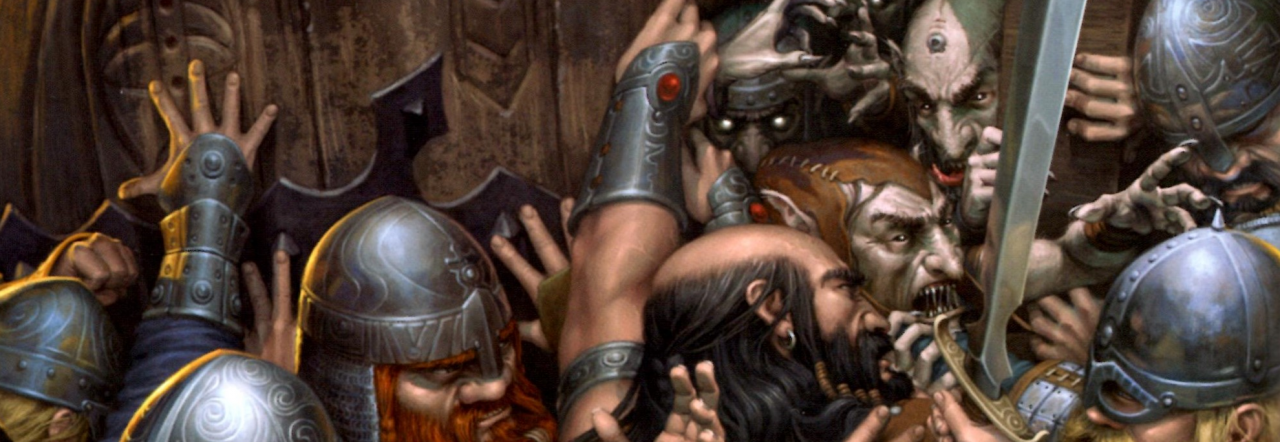
One of the gorgeous full-page pieces of art by RU-MOR, one of three illustrators to work on the book

Mechanics

The game uses d6’s and I can tell you, you will never need more than twelve at once, which is a nice change of pace from games where you find you run out of dice and have to start rerolling the ones you’ve already used. When it is your turn, you select one unit that has not been activated yet and choose one of three actions, ‘move’, ‘shoot’ or ‘attack’. To represent the line of command, as well as the unit’s individual discipline, you must roll two dice to determine whether the unit follows your command. If it does, then you carry out the activation as normal, if it doesn’t, it ends your turn. In the games we played I approached this mechanic tentatively, expecting to not like the loss of control it inevitably means. However, once we started playing I realised it was great! IT makes the game move faster because it’s always flipping between whose turn it is. It keeps everyone playing involved in the game and is much more inclusive than a true I-GO-U-GO setup. Another unpredictability in the usage of unit’s is the ‘Wild Charge’ mechanic.  Units with this special rule must attempt to charge the enemy if they are within range. It creates some very interesting emergent gameplay and makes the game feel like you as commander have to be more reactive rather than calculating every move with utmost delicacy. In this sense I feel as though Dragon Rampant is the most ‘real’ fantasy wargame I’ve ever played. I feel more like a commander having to send out his orders and react to the unexpected tides of battle. It feels more like a battle and less like chess.

Continue reading “Review: Dragon Rampant”

Concerning Umberto Eco

So the Italian author Umberto Eco died a few weeks ago. It was a big enough event to have made national news. I have never read the novel which made him famous, The Name of the Rose, and if I’m being frank, I’m not likely to. However, he is worth a mention from me here because his work as an academic and essayist has massively influenced my own choice of studies and professional interest, both as an undergraduate, and a post-graduate.  I came across his work when I was asked to write an essay on medievalism and modern-medieval culture as an undergraduate. I, as anyone who knows me won’t be surprised to know, decided to write an essay on Dungeons and Dragons. What better way to sneak gaming into something real. My lecturer at the time insisted I make use of an essay by Eco. The essay was entitled ‘Dreaming of the Middle Ages’ in which Eco talks about the different ways that society reinvents the ‘middle ages’ for its own end. It was definitely interesting and for me, it set me down a path that for most of my time in education, I clung to.

So let’s add a few years. When I started my masters’ degree it was hard to

Umberto Eco, 1931-2016

ignore Eco. In fact he was so relevant I referenced him in nearly every piece of coursework I did. For anyone wanting to have a good, insightful read about how the stories of our society are constructed, look to Travels in Hyper-Reality, which is the collection that ‘Dreaming of the Middle Ages’ comes from. It’s wonderful. I managed to track down a copy for myself a few months ago which alas wasn’t easy, partly to do with the fact I don’t think it’s in print anymore. His essays about what academics like to refer to as ‘medievalism’, that is the use of medieval tropes and things that are perceived as ‘medieval’ to create a narrative that people are immediately comfortable with. I suppose the modern, most relevant equivalent of this would be HBO’s Game of Thrones. Eco’s arguments were that things like Game of Thrones are not medieval at all, and instead use a mythologised version of the medieval to map modern thought and storytelling onto. Ergo, Game of Thrones is not medieval at all; it’s simply what we as an audience perceive to be medieval. Continue reading “Concerning Umberto Eco”

Concerning Vapnartak

Every February the York Wargames Society hosts a wargaming convention called Vapnartak. I’ve been lucky enough to be able to attend for the last three years and had a blast every time (and even once managed to convince my partner to go with me). They have a good balance of traders, participation games and demonstrations on, as well as a very good table sale. The convention is split over three floors of the Knavesmire Stand at York Racecourse, with usually the big tables being on the ground floor and the traders sprinkled about all three. For anyone who has a love of miniatures and can get there within the day, I’d recommend it. There’s often several of the big names in the industry there; Warlord, Pendraken, Mantic (though Mantic were not there this year). Of course, Games Workshop doesn’t attend.

This year I noticed that easily the largest game being played was a game of Kings of War by Mantic Games. It was an interesting sight to see, as the game has only recently surged in popularity, especially with the release of its second edition.  To see it being played at an event and even binge the biggest game there was nice because I’ve felt for the last few years that Kings of War is superior to Warhammer.

Continue reading “Concerning Vapnartak”