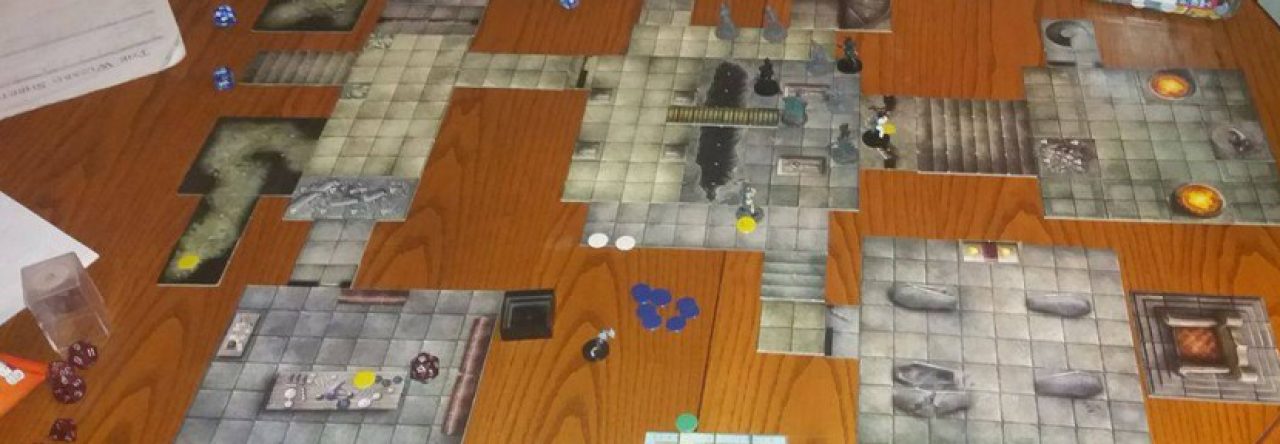
Mordheim Miniatures: Witch Hunters

Witch Hunters and Warrior Priests

For those of you unfamiliar with Mordheim, let me enlighten you. Mordheim is an out-of-print skirmish game by Games Workshop. It is set in the Warhammer Fantasy setting in a ruined city called Mordheim. The city was destroyed when a  two tailed comet crashed into it for the perceived immoral behaviour of its citizens. Those not killed in the initial impact either fled or died a most terrible death during the time that followed. The city became overrun with monsters and heretics seeking the valuable wyrdstones that the comet was made from. For those regulars out there, this article on witch hunters will be similar to my previous budget builds guide and contain links where relevant.

The game was very popular but got stomped like all other specialist games by Games Workshop and now holds what can only be considered a strong cult following. Mordheim still has a very active player base that are constantly coming up with new ways to enjoy this classic, from new warbands to inventive novel scenarios.

However, without official support, sourcing all the models can be a pain, especially if you aren’t into your wargames as much as I am. This guide aims to gather together a collection of miniatures for each of the models in the Witch Hunter warband list, hopefully in an effort to save budding young witch hunters the effort of having to trawl the internet themselves trying to find obscure bits and pieces.

Continue reading “Mordheim Miniatures: Witch Hunters”

Concerning Conversions

A ‘Conversion’ refers to a very specific type of miniature project. There’s no hard and fast rule on how to define this but I’ll do my best. Basically, when a model is converted it means that the modeller has taken pieces from elsewhere, often other kits and added them to a model in order to make it unique. It’s an incredibly fun past time of mine and I’d probably say it’s my favourite part about wargaming in general. Making unique characters and units is very fun. It’s very similar to scratch building a model but not as extreme.

A few of my most beloved miniatures are converted ones and I’d just like to talk about things that are important should you really want to customise your own figures to the max. First of all, save everything. Even the sprues if you can. You never know when you may need that pelt pouch that came with your 40k orks you bought when you were fifteen. This is of course not very space friendly and sprues quickly end up being more effort than they are worth. Instead however, you may want to keep what collectors refer to as a ‘bitz box’. Put in a bit of time and cut off all the spare parts from your sprues and store them in a box (or in my case multiple boxes). I use the plastic boxes that come with takeaway food. It might be a good idea for you, if you have a particular large amount of spare parts to organise them into categories like weapons, sci-fi/fantasy, torsos, etc.

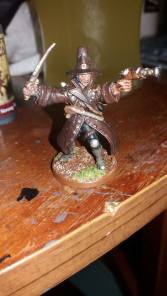
I think it’s also worth talking about non-component related things you should keep a stock of if you like adapting your own minis. The top thing of this is putty; Milliput and Green Stuff. That stuff is a  godsend allowing you to fashion parts for things you don’t usually have. Green Stuff is usually better as Milliput is very brittle, making extremely fine detail things impossible. However, Green Stuff is significantly more expensive but is generally how most miniatures that you own start out as before being turned into moulds for plastic and metal. Both are two part epoxies that generally don’t have a shelf life, buy some today, finish using it in five years’ time. To the right here is a picture of a model I converted, something I added a little bit more character to. It was originally a ‘high inquisitor’ miniature produced for D&D 3.5. However, with the exorbitant prices Games Workshop was asking for their Witch Hunter model, which frankly I don’t like very much, I decided I would adapt this guy into something more lore friendly and characterful of the Old World. I started by highliting the trims with gold and washing the model in a dark army painter tone. I then used Milliput to increase the height of the hat to make it look more like the witch hunters of Warhammer.12919474_1311326088882961_1062426483_o 12921967_1311326108882959_104305521_oI decided I didn’t like the torch and cut it off, replacing it with a pistol I fashioned from the head of a great-ax from the orc sprues that Mantic produce. I added a second pistol to his belt because a witch hunter surelyneed a brace of them not just one. I then read that Witch Hunters often cover themselves in weapons due to the danger of their work. As a result of this, I added two thin swords to his back. After painting his boots rather than keeping them black and colouring the hat extension I had something I was happy with. It was very easy and made the mini stand out in a much more lore-friendly and distinctive way.
Continue reading “Concerning Conversions”

Review: Dragon Rampant

Dragon Rampant, The Definitive Pick-up-and-Play Fantasy Wargame

Overview

So a few weeks ago I got hold of a copy of Dragon Rampant, the fantasy battle rules by Osprey Publishing. The game was released in 2015 and the rules were written by Daniel Mersey, the same delightful chap who did Lion Rampant, the historical medieval rules by Osprey. Anyone coming from Lion Rampant will quickly be at home here as much of the rules are the same. However, Dragon Rampant adds a great deal of fantasy flavour, as to be expected. The book is a fairly slim, approachable volume weighing in at 64 pages. The book itself is clearly laid out (though not indexed) with some stunning artwork. The art really is wonderful, as is usually the case with Osprey. It retails from Osprey themselves for £11.99. Within you will find rules for how to run a battle, as well as the usual wargame stuff; how to handle terrain, how to form cohesive units from your vast collection of miniatures. What is important however is that the rules are generic and allow you to build your own unit types, permitting you the use of any models in your collection. The game generally favours fun over competitiveness, with luck playing a rather large amount in activation of units.

Untitled.png
One of the gorgeous full-page pieces of art by RU-MOR, one of three illustrators to work on the book

Mechanics

The game uses d6’s and I can tell you, you will never need more than twelve at once, which is a nice change of pace from games where you find you run out of dice and have to start rerolling the ones you’ve already used. When it is your turn, you select one unit that has not been activated yet and choose one of three actions, ‘move’, ‘shoot’ or ‘attack’. To represent the line of command, as well as the unit’s individual discipline, you must roll two dice to determine whether the unit follows your command. If it does, then you carry out the activation as normal, if it doesn’t, it ends your turn. In the games we played I approached this mechanic tentatively, expecting to not like the loss of control it inevitably means. However, once we started playing I realised it was great! IT makes the game move faster because it’s always flipping between whose turn it is. It keeps everyone playing involved in the game and is much more inclusive than a true I-GO-U-GO setup. Another unpredictability in the usage of unit’s is the ‘Wild Charge’ mechanic.  Units with this special rule must attempt to charge the enemy if they are within range. It creates some very interesting emergent gameplay and makes the game feel like you as commander have to be more reactive rather than calculating every move with utmost delicacy. In this sense I feel as though Dragon Rampant is the most ‘real’ fantasy wargame I’ve ever played. I feel more like a commander having to send out his orders and react to the unexpected tides of battle. It feels more like a battle and less like chess.

Continue reading “Review: Dragon Rampant”

Review: Runebound

The third edition of Runebound hit stores in Decemeber last year. It is an adventure boardgame by Fantasy Flight Games and is very much marketed at the ‘Adventure-in-a-box’ style game. I think I should start by stating that I have never player any other edition of Runebound so I only have this one to go off. Whether that makes me ill-informed or more impartial is up to you. Straight away, as soon as the lid comes off the box you can sense the production value of the game, something that folks who know Fantasy Flight will be used to. The cards, the board and the miniatures are all beautiful. Though I’d like to just mention that Fantasy Flight have seemed to have switched from putting standard rulebooks in their games to two volumes; a ‘learn-to-play’ guide and a ‘rules reference’. I’m not sure what the reason for this was, I imagine it has something to do with making the rules easier to understand for a new player but I have found this new way of doing things (both in Runebound and other FFG titles) to be unintuitive. I find myself, or my friends, spend half the time asking which book the answer to an obscure rules question is in rather than playing. I’d be interested to hear other people’s views on this and if others have found this newer system more useful and why.

In Runebound each player assumes control of one of six characters and must travel the realm of Terrinoth collecting items and becoming more powerful. Each character is significantly different from the others and my only gripe is that there aren’t more of them. It’s a game that, in terms of appeal and atmosphere, is very similar to Talisman, for me at least. When you factor in that in a six player game you have no choice in who you play it feels worse than it probably should. I was expecting more characters and it’s a shame they’re a bit scarce. The board itself is divided into hexes and uses custom dice to determine how far a character may travel each turn by rolling a number of movement dice equal to the characters movement score and then allocating them as they see fit to terrain tiles on the board. This is where Runebound shines, and where for me it becomes praise worthy game. I enjoy the fact that the encounter decks are split into three different types; combat, exploration and social and it give me a real sense of adventure. Some of the encounters are very interesting, becoming a permanent fixture on the board and the fact that these draw decks are modified by the rules of the game’s scenario. We had one game where, as the vile dragonlord Margath was slowly building his power (the first of two scenarios that ship with the game) that a heretical cult of dragon worshippers set up shop in one of the outlying towns of Terrinoth. This changed how we played because anyone entering the town was subject to the cults wroth and as result we avoided the place like the plague.

Another element that I really enjoy about Runebound is the semi-co-operative elements to it (I have a serious love for anything that lets me quest with my friends). There is only one winner to the game, but to achieve that goal the player must work with others otherwise everyone loses. In the first scenario is ‘The Ascendance of Margath’ in which the aforementioned Margath the dragnlord is getting ready to slither out of his hiding place in the Mountains of Despair and attack the city of Tamalir. The game involved players getting ready for a final showdown when the dragon finally rears his ugly head. Continue reading “Review: Runebound”

Concerning Umberto Eco

So the Italian author Umberto Eco died a few weeks ago. It was a big enough event to have made national news. I have never read the novel which made him famous, The Name of the Rose, and if I’m being frank, I’m not likely to. However, he is worth a mention from me here because his work as an academic and essayist has massively influenced my own choice of studies and professional interest, both as an undergraduate, and a post-graduate.  I came across his work when I was asked to write an essay on medievalism and modern-medieval culture as an undergraduate. I, as anyone who knows me won’t be surprised to know, decided to write an essay on Dungeons and Dragons. What better way to sneak gaming into something real. My lecturer at the time insisted I make use of an essay by Eco. The essay was entitled ‘Dreaming of the Middle Ages’ in which Eco talks about the different ways that society reinvents the ‘middle ages’ for its own end. It was definitely interesting and for me, it set me down a path that for most of my time in education, I clung to.

So let’s add a few years. When I started my masters’ degree it was hard to

Umberto Eco, 1931-2016

ignore Eco. In fact he was so relevant I referenced him in nearly every piece of coursework I did. For anyone wanting to have a good, insightful read about how the stories of our society are constructed, look to Travels in Hyper-Reality, which is the collection that ‘Dreaming of the Middle Ages’ comes from. It’s wonderful. I managed to track down a copy for myself a few months ago which alas wasn’t easy, partly to do with the fact I don’t think it’s in print anymore. His essays about what academics like to refer to as ‘medievalism’, that is the use of medieval tropes and things that are perceived as ‘medieval’ to create a narrative that people are immediately comfortable with. I suppose the modern, most relevant equivalent of this would be HBO’s Game of Thrones. Eco’s arguments were that things like Game of Thrones are not medieval at all, and instead use a mythologised version of the medieval to map modern thought and storytelling onto. Ergo, Game of Thrones is not medieval at all; it’s simply what we as an audience perceive to be medieval. Continue reading “Concerning Umberto Eco”

Concerning Vapnartak

Every February the York Wargames Society hosts a wargaming convention called Vapnartak. I’ve been lucky enough to be able to attend for the last three years and had a blast every time (and even once managed to convince my partner to go with me). They have a good balance of traders, participation games and demonstrations on, as well as a very good table sale. The convention is split over three floors of the Knavesmire Stand at York Racecourse, with usually the big tables being on the ground floor and the traders sprinkled about all three. For anyone who has a love of miniatures and can get there within the day, I’d recommend it. There’s often several of the big names in the industry there; Warlord, Pendraken, Mantic (though Mantic were not there this year). Of course, Games Workshop doesn’t attend.

This year I noticed that easily the largest game being played was a game of Kings of War by Mantic Games. It was an interesting sight to see, as the game has only recently surged in popularity, especially with the release of its second edition.  To see it being played at an event and even binge the biggest game there was nice because I’ve felt for the last few years that Kings of War is superior to Warhammer.

Continue reading “Concerning Vapnartak”

Adventure: Snapshank Canyon

So this was an adventure I put together just after the release of the 5th Edition of Dungeons and Dragons. I usually document adventures like this on a personal wiki my group keeps and I thought it may be good to share with other people that fancy a quick, combat heavy adventure site to play, especially since the D&D 5th OGL has just gone live.

Snapshank Canyon

Snapshank Canyon is a small adventure site for first level characters. By the end they should either be 3rd level, or very close.

When they reach the canyon read the following description.

You have reached Snapshank Canyon. The gully entrance is fenced off by a high palisade and about the craggy hillside you can see several buildings that have been constructed, each connected by bridges. The entrance to the gully is watched over by a guard tower.

The players can approach this in many ways. The guard atop the tower has good visibility on anyone trying to enter. However, like many bandits he has a vice for ale and on an evening is often drunk, making it easier to sneak in. If he detects intruders he will sound the alarm, attracting the attention of people in area 1.

Continue reading “Adventure: Snapshank Canyon”

Concerning Conan

I find myself drawn ever back to the murky, monster filled jungles and deserts of Robert E. Howard’s Hyborian Age. A few years ago I got my hands on a collection of all the Conan Tales and read them from back to front. At the time I was an undergraduate and my interest for the vile sorceries of Conan’s world grew so passionate I largely based my undergraduate dissertation on it (along with several other pulp stories). I find I constantly want it to be considered literature, and often wonder why it isn’t by most people. I imagine it’s partly to do with the low brow nature of it; it’s escapist, easy fun about a strong warrior who saves countless damsels from the clutches of gibbering demons and mad wizards. I find another part of Howard’s rejection from scholarly discussion, when compared to similar writers of the time like H.P Lovecraft, is partly to do with the reinvention of the Continue reading “Concerning Conan”