It seems that I have left this blog by the wayside, which is a shame. The commitments of work have endowed me with a dearth of time over the past few years and the endless the lack of compulsion to write anything here has compounded this. However, it seems that given the circumstances of The Plague and the extra time it has given me that I should like to post some more things here, which have always been little more than a random assemblage of my interests without much forethought or care.
Clement Atlee once said of the final volume of Churchill’s A History of the English Speaking Peoples that it should have been entitled ‘Things From History that I find Interesting’ due it’s random and unfocused content. He had a point, but so did Churchill and his animus infests this sort of blog like the wriggling necromantic magic in your common garden variety zombie. Though ‘Things About Tabletop Gaming that I Find Interesting’ might be better for me.
One of the biggest things that puts people of wargaming is the cost. But it doesn’t have to be like that. I’m here today to show you how you can build a 1500 point Kingdoms of Men army for Kings of War for £101 that is adaptable and completely playable, with the extra option of painting it up. With no official models for this army, it can be daunting for a new player to approach this faction, especially if they have little experience of the hobby as a whole. Below is the army list I will be working on. I believe it is reasonably well balanced for the tabletop and you should have no problem in using it yourself, even if you are a newcomer to the game.
So recently I’ve really gotten back into computer gaming, especially with the release of the new 7 Days to Die build. For anyone unfamiliar with the title, 7 Days is a game in which you, and perhaps some friends, attempt to survive in a random or pre-generated world full of zombies. I’ll admit that this one scratches my survival itch a lot more than Minecraft ever did, without being, more or less, focused on PvP like DayZ or Rust. So it’s co-op, huzzah! The game allows you to modify structures you find in the world to make them more suitable, or build an entirely new one from scratch. I find converting buildings to be more fun. It takes less time and makes it feel more like a proper zombie apocalypse.
Every character has hunger, thirst and temperature, all of which have to be regulated or you will die. Early game this has meant scavenging through buildings, with the pack at our heels, looking for tins of soup and dog food. Killing zombies can also be quite fruitful once you get the hang of it. Though by far the best way we found of getting food was farming. We set up shop in a small fishing hut next to a lake. The choice was obvious for us when we came across it. An easy supply of water, a building made of metal. It also has the added bonus of an easy escape; zombies can’t swim you see, but we can. Usually in the game, zombies walk during the day and run at night. We didn’t really like this feature, though I can see why some people would. So instead the options menu allowed us to make them walk all the time. To counteract this obvious plummet in difficulty, we increased the amount of zombies that spawn at all times by fifty-percent. Hordes became much more horde-like.
A ‘Conversion’ refers to a very specific type of miniature project. There’s no hard and fast rule on how to define this but I’ll do my best. Basically, when a model is converted it means that the modeller has taken pieces from elsewhere, often other kits and added them to a model in order to make it unique. It’s an incredibly fun past time of mine and I’d probably say it’s my favourite part about wargaming in general. Making unique characters and units is very fun. It’s very similar to scratch building a model but not as extreme.
A few of my most beloved miniatures are converted ones and I’d just like to talk about things that are important should you really want to customise your own figures to the max. First of all, save everything. Even the sprues if you can. You never know when you may need that pelt pouch that came with your 40k orks you bought when you were fifteen. This is of course not very space friendly and sprues quickly end up being more effort than they are worth. Instead however, you may want to keep what collectors refer to as a ‘bitz box’. Put in a bit of time and cut off all the spare parts from your sprues and store them in a box (or in my case multiple boxes). I use the plastic boxes that come with takeaway food. It might be a good idea for you, if you have a particular large amount of spare parts to organise them into categories like weapons, sci-fi/fantasy, torsos, etc.
I think it’s also worth talking about non-component related things you should keep a stock of if you like adapting your own minis. The top thing of this is putty; Milliput and Green Stuff. That stuff is a godsend allowing you to fashion parts for things you don’t usually have. Green Stuff is usually better as Milliput is very brittle, making extremely fine detail things impossible. However, Green Stuff is significantly more expensive but is generally how most miniatures that you own start out as before being turned into moulds for plastic and metal. Both are two part epoxies that generally don’t have a shelf life, buy some today, finish using it in five years’ time. To the right here is a picture of a model I converted, something I added a little bit more character to. It was originally a ‘high inquisitor’ miniature produced for D&D 3.5. However, with the exorbitant prices Games Workshop was asking for their Witch Hunter model, which frankly I don’t like very much, I decided I would adapt this guy into something more lore friendly and characterful of the Old World. I started by highliting the trims with gold and washing the model in a dark army painter tone. I then used Milliput to increase the height of the hat to make it look more like the witch hunters of Warhammer.I decided I didn’t like the torch and cut it off, replacing it with a pistol I fashioned from the head of a great-ax from the orc sprues that Mantic produce. I added a second pistol to his belt because a witch hunter surelyneed a brace of them not just one. I then read that Witch Hunters often cover themselves in weapons due to the danger of their work. As a result of this, I added two thin swords to his back. After painting his boots rather than keeping them black and colouring the hat extension I had something I was happy with. It was very easy and made the mini stand out in a much more lore-friendly and distinctive way.
MARS ATTACKS was originally a set of collectable and tradable cards released in 1962 for children. The original set contained 55 cards and each one detailed an aspect of the Martian invasion of Earth, and the eventual resistance and counter-invasion of Mars by humanity. Topps, the owners of the series, had to end production of the cards prematurely because the violence depicted and the implied sexuality of certain cards. My first experience of MARS ATTACKS was the 90’s film by Tim Burton. It’s bad, it’s really bad. I love it. MARS ATTACKS has always had a good sense of dark humour and the film captured that wonderfully. The giant brained, bog-eyed Martians evoke that camp, over the top comedy so well. I heard as well that the iconic ‘ack ack’ noises that the Martians of the film make is actually the quacking of a duck played backwards.
Card no. 36. My all time favourite.
It wasn’t until a while later however that I really began to appreciate the silliness of MARS ATTACKS in any meaningful way. In October 2013 Mantic Games ran a Kickstarter for their MARS ATTACKS miniatures game. I’ve had a quiet respect for Mantic for the last few years and was sold fairly quickly on the idea of 28mm Martians with freeze/death/heat rays against hapless soldiers. I suppose this pose is a semi-review of that game, as well as a discussion of the series as a whole.
When my pledge arrived I was astounded at how much they’d given me for my money, as well as the quality of the items. The rules are derived from Mantic’s other game, Deadzone, albeit simplified so anyone can pick it up. My brother isn’t really into miniature wargaming but I managed to convince him to give this one a go and we had a blast. The randomness of the rules create a truly over the top feel. He, playing as the Martians, pressed my poor soldiers back through the ruins, killing them all with disintegration rifles. As he was about the finish off the last few of the remaining members of my band of brothers something unexpected happened. A herd of flaming cows came reeling in from off the board and trampled his alien friends. In quick succession, before the Martians could recover, a giant spider erupted from the ground, the result of weird Martian science, and began devouring the scattered aliens. I seized the opportunity and pressed the attack. I think I still lost that game in the end, I can’t remember too well, though what I do remember is that it was fun and funny.
So the new Ravenloft-based adventure Curse of Strahd for Dungeons and Dragons is set for release in just over a week release next week so I thought it might be a good time to look back over at the original Ravenloft module by Laura and Tracy Hickman. I am fortunate enough to have partner that tracked down a copy of the module and I received it as a Christmas present a few years ago. Hopefully this post will help explain to people a bit of the history of Ravenloft and how it fits into the bigger D&D picture. Beneath is a scan of my copy’s cover page.
We can see that on the cover is Strahd, the vampire lord that features prominently in the upcoming module for 5th edition. He’s a Dracula type figure that has a tortured past and that was one of the things that made Ravenloft different. Previous to the publication of the module enemies and NPCs were simply in the game to give the players something to kill or to talk to. The Hickmans changed this; they made the villain the centre of the story. Strahd is the story in Ravenloft and that revolutionized the approach to adventure design. No longer could you simply have a series of unconnected rooms in a dungeon that didn’t make sense outside of itself. The characterization of Strahd as a villain helped peel away the wild and wooly adventure design of the 1970’s and replace it with something more meaningful.
So in addition to Strad what else have we got? We can see that the adventure is labelled as ‘I6’, meaning, for those unfamiliar with AD&D modules that it was the 6th adventure in the ‘I’ series. ‘I’ stands for intermediate, and it was mostly a series of unconnected adventures, though Ravenloft is one of the few within the series to get a sequel. We can also see that the adventure is intended for ‘6 to 8 characters of levels 5 to 7’. This reveals a difference in the game design culture and the understanding of how many PC’s would be in the game. I, along with most people who play D&D I presume would consider eight player characters quite a lot, maybe too many for some people. It reveals that, both the rules for AD&D were faster and simpler (well, I’d ague about simplicity…) and that life was cheaper back in 1st E AD&D.
So the Italian author Umberto Eco died a few weeks ago. It was a big enough event to have made national news. I have never read the novel which made him famous, The Name of the Rose, and if I’m being frank, I’m not likely to. However, he is worth a mention from me here because his work as an academic and essayist has massively influenced my own choice of studies and professional interest, both as an undergraduate, and a post-graduate. I came across his work when I was asked to write an essay on medievalism and modern-medieval culture as an undergraduate. I, as anyone who knows me won’t be surprised to know, decided to write an essay on Dungeons and Dragons. What better way to sneak gaming into something real. My lecturer at the time insisted I make use of an essay by Eco. The essay was entitled ‘Dreaming of the Middle Ages’ in which Eco talks about the different ways that society reinvents the ‘middle ages’ for its own end. It was definitely interesting and for me, it set me down a path that for most of my time in education, I clung to.
So let’s add a few years. When I started my masters’ degree it was hard to
Umberto Eco, 1931-2016
ignore Eco. In fact he was so relevant I referenced him in nearly every piece of coursework I did. For anyone wanting to have a good, insightful read about how the stories of our society are constructed, look to Travels in Hyper-Reality, which is the collection that ‘Dreaming of the Middle Ages’ comes from. It’s wonderful. I managed to track down a copy for myself a few months ago which alas wasn’t easy, partly to do with the fact I don’t think it’s in print anymore. His essays about what academics like to refer to as ‘medievalism’, that is the use of medieval tropes and things that are perceived as ‘medieval’ to create a narrative that people are immediately comfortable with. I suppose the modern, most relevant equivalent of this would be HBO’s Game of Thrones. Eco’s arguments were that things like Game of Thrones are not medieval at all, and instead use a mythologised version of the medieval to map modern thought and storytelling onto. Ergo, Game of Thrones is not medieval at all; it’s simply what we as an audience perceive to be medieval. Continue reading “Concerning Umberto Eco”→
Every February the York Wargames Society hosts a wargaming convention called Vapnartak. I’ve been lucky enough to be able to attend for the last three years and had a blast every time (and even once managed to convince my partner to go with me). They have a good balance of traders, participation games and demonstrations on, as well as a very good table sale. The convention is split over three floors of the Knavesmire Stand at York Racecourse, with usually the big tables being on the ground floor and the traders sprinkled about all three. For anyone who has a love of miniatures and can get there within the day, I’d recommend it. There’s often several of the big names in the industry there; Warlord, Pendraken, Mantic (though Mantic were not there this year). Of course, Games Workshop doesn’t attend.
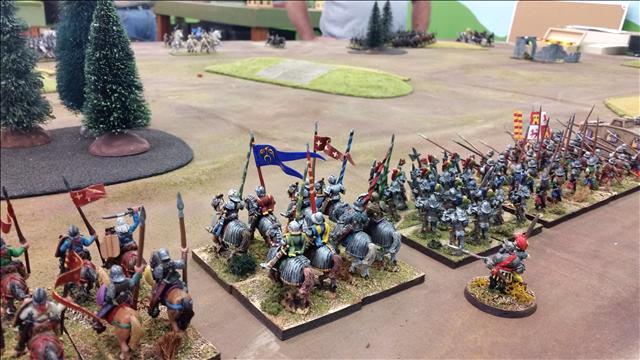
This year I noticed that easily the largest game being played was a game of Kings of War by Mantic Games. It was an interesting sight to see, as the game has only recently surged in popularity, especially with the release of its second edition. To see it being played at an event and even binge the biggest game there was nice because I’ve felt for the last few years that Kings of War is superior to Warhammer.
I’ll admit now, I love 2000AD. I love the thinly veiled political satire, the weird fiction and the sci-fi. It’s nigh impossible to talk about 2000AD, one of the few things I think good enough for me to maintain an ongoing subscription to, without talking about Judge Dredd. I’ll start at the beginning for those of you who are unfamiliar with the character. Dredd is not a superhero. A few people I’ve mentioned him to have had this misconception so I’ll deal with it first. He simply isn’t when the world he lives in is taken into context. The world of Judge Dredd is a post-nuclear dystopia in which the remains of humanity have
Call-Me-Kenneth goes rogue
gathered themselves into huge metropolitan centres, thousands of miles large known as Mega Cities. Mega City One is Judge Dredd’s home. To keep law and order in the big Megs humanity has more or less signed itself over to an unquestionable, indisputable police state. This authority takes its form as the Justice Department, and it’s judges. Judges are people that have been trained from childhood to enforce the law and are able to act as judge jury and, if necessary, executioner. They are armed with the Continue reading “Concerning Judge Dredd”→
I find myself drawn ever back to the murky, monster filled jungles and deserts of Robert E. Howard’s Hyborian Age. A few years ago I got my hands on a collection of all the Conan Tales and read them from back to front. At the time I was an undergraduate and my interest for the vile sorceries of Conan’s world grew so passionate I largely based my undergraduate dissertation on it (along with several other pulp stories). I find I constantly want it to be considered literature, and often wonder why it isn’t by most people. I imagine it’s partly to do with the low brow nature of it; it’s escapist, easy fun about a strong warrior who saves countless damsels from the clutches of gibbering demons and mad wizards. I find another part of Howard’s rejection from scholarly discussion, when compared to similar writers of the time like H.P Lovecraft, is partly to do with the reinvention of the Continue reading “Concerning Conan”→

 Every character has hunger, thirst and temperature, all of which have to be regulated or you will die. Early game this has meant scavenging through buildings, with the pack at our heels, looking for tins of soup and dog food. Killing zombies can also be quite fruitful once you get the hang of it. Though by far the best way we found of getting food was farming. We set up shop in a small fishing hut next to a lake. The choice was obvious for us when we came across it. An easy supply of water, a building made of metal. It also has the added bonus of an easy escape; zombies can’t swim you see, but we can. Usually in the game, zombies walk during the day and run at night. We didn’t really like this feature, though I can see why some people would. So instead the options menu allowed us to make them walk all the time. To counteract this obvious plummet in difficulty, we increased the amount of zombies that spawn at all times by fifty-percent. Hordes became much more horde-like.

 I decided I didn’t like the torch and cut it off, replacing it with a pistol I fashioned from the head of a great-ax from the orc sprues that Mantic produce. I added a second pistol to his belt because a witch hunter surelyneed a brace of them not just one. I then read that Witch Hunters often cover themselves in weapons due to the danger of their work. As a result of this, I added two thin swords to his back. After painting his boots rather than keeping them black and colouring the hat extension I had something I was happy with. It was very easy and made the mini stand out in a much more lore-friendly and distinctive way.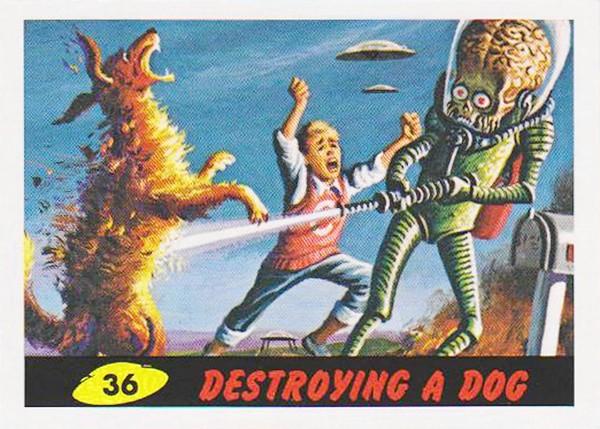


 Vault of the Geek