
A ‘Conversion’ refers to a very specific type of miniature project. There’s no hard and fast rule on how to define this but I’ll do my best. Basically, when a model is converted it means that the modeller has taken pieces from elsewhere, often other kits and added them to a model in order to make it unique. It’s an incredibly fun past time of mine and I’d probably say it’s my favourite part about wargaming in general. Making unique characters and units is very fun. It’s very similar to scratch building a model but not as extreme.
A few of my most beloved miniatures are converted ones and I’d just like to talk about things that are important should you really want to customise your own figures to the max. First of all, save everything. Even the sprues if you can. You never know when you may need that pelt pouch that came with your 40k orks you bought when you were fifteen. This is of course not very space friendly and sprues quickly end up being more effort than they are worth. Instead however, you may want to keep what collectors refer to as a ‘bitz box’. Put in a bit of time and cut off all the spare parts from your sprues and store them in a box (or in my case multiple boxes). I use the plastic boxes that come with takeaway food. It might be a good idea for you, if you have a particular large amount of spare parts to organise them into categories like weapons, sci-fi/fantasy, torsos, etc.
I think it’s also worth talking about non-component related things you should keep a stock of if you like adapting your own minis. The top thing of this is putty; Milliput and Green Stuff. That stuff is a godsend allowing you to fashion parts for things you don’t usually have. Green Stuff is usually better as Milliput is very brittle, making extremely fine detail things impossible. However, Green Stuff is significantly more expensive but is generally how most miniatures that you own start out as before being turned into moulds for plastic and metal. Both are two part epoxies that generally don’t have a shelf life, buy some today, finish using it in five years’ time. To the right here is a picture of a model I converted, something I added a little bit more character to. It was originally a ‘high inquisitor’ miniature produced for D&D 3.5. However, with the exorbitant prices Games Workshop was asking for their Witch Hunter model, which frankly I don’t like very much, I decided I would adapt this guy into something more lore friendly and characterful of the Old World. I started by highliting the trims with gold and washing the model in a dark army painter tone. I then used Milliput to increase the height of the hat to make it look more like the witch hunters of Warhammer.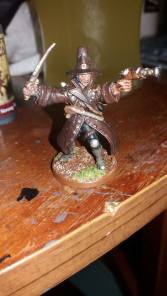

 I decided I didn’t like the torch and cut it off, replacing it with a pistol I fashioned from the head of a great-ax from the orc sprues that Mantic produce. I added a second pistol to his belt because a witch hunter surelyneed a brace of them not just one. I then read that Witch Hunters often cover themselves in weapons due to the danger of their work. As a result of this, I added two thin swords to his back. After painting his boots rather than keeping them black and colouring the hat extension I had something I was happy with. It was very easy and made the mini stand out in a much more lore-friendly and distinctive way.



 where, as the vile dragonlord Margath was slowly building his power (the first of two scenarios that ship with the game) that a heretical cult of dragon worshippers set up shop in one of the outlying towns of Terrinoth. This changed how we played because anyone entering the town was subject to the cults wroth and as result we avoided the place like the plague.


 Vault of the Geek