Games Workshop announced last year that they would be republishing three of the most cherished Warhammer Fantasy graphic novel compilations. Of course I immediately got hold of three of all three and gave them a read. The three lucky enough to get selected were Condemned by Fire, Forge of War, and Crown of Destruction. Below is my look at each in turn.
Condemned by Fire
Rapier and Pistol in the Grim World of Warhammer
The graphic novel was written by Dan Abnett. I’d never actually had the pleasure of giving it a read, which is strange, seen as I absolutely love Warhammer’s witch hunters. The basic plot sees Magnus Gault, a witch hunter of the Order of the Silver Hammer tracking down a heretic called Magister. Now, anyone who follows this blog will now that I love witch hunters. So this one had to be good. The blasphemous wretch is hunting eventually seeks refuge in a forgotten village called Loughville which Magnus is warned is the site of some foul sorcerous evil. Being the hardened witch hunter, he decides to go to Loughville to finish off Magister, only to realise that the place has been taken over by worshippers of Nurgle, the father of Decay. Magister has been killed by their unholy diseases and they attempt to inflict the same fate on Gault. He breaks free and through guile and wit overcomes them and sees them all blown to pieces. He then realises that the chaos taint was spread in the water. This causes him to then begin tracking the river back to its source. The story then becomes and episodic adventure with Gault moving from place to place overcoming enemies using his rapier, pistol and sheer Sigmarite faith. He meets two companions along the way. The first Franz Vogel, an imperial Greatsword of the Averland province. The second is Vargni Valnirsson, a dwarf. While I really enjoyed watching Vogel and Gault beat up various enemies together, I feel that Vargni was introduced too late in the book for me to feel any significant attachment to him. The plot is reasonably predictable as is to be expected of anything to do with Warhammer. It does however, allow itself a few twists and turns, including who is behind the taint in the river (hint: it isn’t followers of chaos!) and some various details pertaining to specific characters.
The primary artists, Ian Edginton and Rahsan Ekedal, really evoke a real sense of the dark and brooding nature of the Warhammer world with their bright and crisp artwork. When Franz Vogel tells his story, we’re treated to a different artist which really allows us to experience that micro-story in a different and original way. The explosions and fighting are visceral, violent and vibrant, something which does the book credit. Overall I would recommend this republication of Condemned by Fire to anyone who likes Warhammer Fantasy and misses the Old World. I hope that this might signal a return of fantasy novels by Black library. I won’t however hold my breath just yet.
Forge of War
Blood and Gore in the Warhammer World
The second of the republished Warhammer Fantasy graphic novels that I got hold of was Forge of War. Let me start first of all by saying that this should without a doubt be read first. It outlines many of the characters and plot details that are used in Condemned by Fire. One of my biggest complaints in Condemned by Fire was that Vargni the dwarf was introduced too fast with little exposition. His exposition is in this one and I would have appreciated before reading Condemned by Fire. Alas, the Black Library failed to inform me which was first.
So onto the meat of Forge of War. It’s a fairly straight-forward Chaos invasion storyline that we expect from Warhammer. Dan Abnett, the author, manages however to ply us with some interesting side plots and unexpected twists. The story mainly deals with a battle involving Empire Averlanders and Dwarves against the ruinous powers of Choas. The main cast includes Sergeant Franz Vogel, his second in command Frohlich, Vargni Valnirsson and a wizard called Konig. The initial portion of the book deals with the battle, but most of 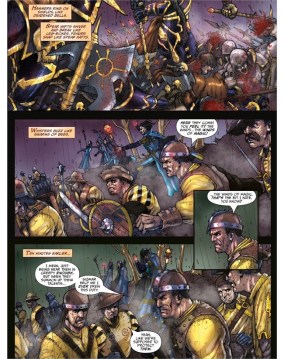 story takes place elsewhere. The men, for some unknown but obvious sorcerous reason, lose heart and flee the field of battle. Vogel, Frohlich and the rest of their greatsword cronies rout into a nearby forest and have to avoid the hunting warriors of Chaos. Eventually Vogel passes out and wakes up in a nearby temple. The women there tend him
and ensure his men are healed. These nurses however, are not what they seem and the
men realise they are in more danger than they initially realised. I won’t spoil what they are, only that this is a very interesting distraction for the reader and for the greatswords. The celestial wizard Konig (who, rather comically, repeatedly introduces himself as ‘Master Konig, Wizard of the Celestial Order’, and the man to save him during the battle, Enz, are also fleeing across the country side. Vargni is captured by the enemy and he and his other prisoners scheme for his escape. He succeeds in slipping out into the wilderness The three groups eventually meet and rally the elector counts now wild griffon and begin to block passages in the mountains. This is with the purpose of driving the advancing chaos horde through one narrow gap and dying in a blaze of glory in a 300 style showdown.
We never actually find out the result of the battle until the second act of Condemned by Fire, but the ending is suitably, Sigmaritely epic all the same. I’d like to congratulate Abnett on writing a war story that kept me interested seen as I usually view those types of plots as a bit dry and over done. Edginton and Ekedal once again do an absolutely superb job with the art work. The colours and linework brings alive the horrors and spectacles of the the grim Old World of Warhammer Fantasy. I really enjoyed this one, and in hindsight feel like a hamstringed my enjoyment of Condemned by Fire by not reading this one first. You can find the republished version on the Black Library here.
Crown of Destruction
Necromancy, Gunpowder And The Crown of Destruction
Crown of Destruction sits comfortably on the end of this trio with some familiar faces and an interesting story. We get treated to more of the grim Warhammer Old World than in the previous two and this is much to the story’s credit. We see Frohlich from Forge of War return. Though this time he’s a main character, rather than a supporting one. The story opens with a delightful looking chap, obviously a necromancer, sacrificing people. We aren’t given much context as to why, which is enough to get the mystery going.
We then cut to Frohlich and his group of Averland greatswords who are camped within the wilderness of the Empire. They are set upon by ravenous hordes of Skaven. They realise that the Skaven are most likely roused due to activity at a nearby castle and the theft of 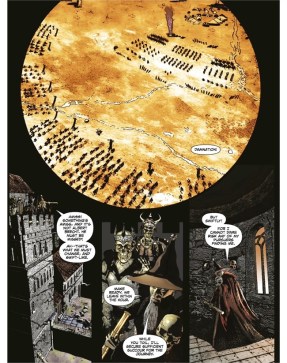 their ‘crown’. Frohlich takes his men and heads over, discovering it to be the haunt of the necromancer at the beginning. They bash their way through the undead cronies with shotte and bolt. Eventually they subdue him after a wonderfully illustrated fight. He was on the cusp of finishing some horrific ritual. They drag him back to camp and it is then revealed that he is both mad and brilliant. He stole one of the Skaven’s warpstone crowns to prolong his life. It is also revealed that his current unnatural longevity was gifted to him by a vampire lord. The men fight furiously to hold back the Skaven that harry them on all sides. It isn’t until Brecht, the necromancer, finishes his tale that the vampire lord shows up to punish his runaway servant. Brecht pleas for his life to little avail and the undead force joins the fray. Frohlich rallies his men again and again in order to make them stand against both forces to little avail. The Averlanders are slowly ground up and the battle begins to look dire. It’s only through their guile and wit that they manage to overcome both the Skaven and the vampire lord.
I will admit that I wasn’t a fan of the artwork in Crown of Destruction. This was probably just a preference thing but it seemed as though the images were produced using 3D rendering technology. This gives a lot of the images a slightly-rotoscoped look which doesn’t feel right for a comic. Where the art does come through is when it uses it’s 3Dish look to show depth. An example of this is where we’re treated to a still of a bullet flying out the end of a flintlock pistol towards the viewers perspective. This is where this artword thrives, in images full of motion and action. Overall I found the story to be well paced and less patchwork than Condemned by Fire and I felt like this was the one that best represented the Warhammer world in all it’s glory. I’d really recommened you pick this one up, as well as the other two from the Black Library.
 Vault of the Geek