Dragon Rampant, The Definitive Pick-up-and-Play Fantasy Wargame
Overview
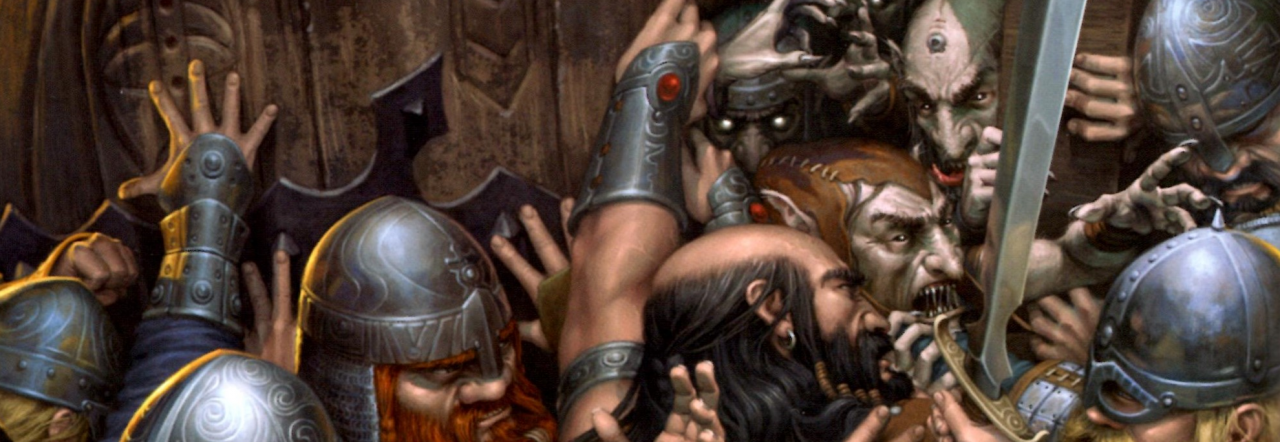
So a few weeks ago I got hold of a copy of Dragon Rampant, the fantasy battle rules by Osprey Publishing. The game was released in 2015 and the rules were written by Daniel Mersey, the same delightful chap who did Lion Rampant, the historical medieval rules by Osprey. Anyone coming from Lion Rampant will quickly be at home here as much of the rules are the same. However, Dragon Rampant adds a great deal of fantasy flavour, as to be expected. The book is a fairly slim, approachable volume weighing in at 64 pages. The book itself is clearly laid out (though not indexed) with some stunning artwork. The art really is wonderful, as is usually the case with Osprey. It retails from Osprey themselves for £11.99. Within you will find rules for how to run a battle, as well as the usual wargame stuff; how to handle terrain, how to form cohesive units from your vast collection of miniatures. What is important however is that the rules are generic and allow you to build your own unit types, permitting you the use of any models in your collection. The game generally favours fun over competitiveness, with luck playing a rather large amount in activation of units.

Mechanics
The game uses d6’s and I can tell you, you will never need more than twelve at once, which is a nice change of pace from games where you find you run out of dice and have to start rerolling the ones you’ve already used. When it is your turn, you select one unit that has not been activated yet and choose one of three actions, ‘move’, ‘shoot’ or ‘attack’. To represent the line of command, as well as the unit’s individual discipline, you must roll two dice to determine whether the unit follows your command. If it does, then you carry out the activation as normal, if it doesn’t, it ends your turn. In the games we played I approached this mechanic tentatively, expecting to not like the loss of control it inevitably means. However, once we started playing I realised it was great! IT makes the game move faster because it’s always flipping between whose turn it is. It keeps everyone playing involved in the game and is much more inclusive than a true I-GO-U-GO setup. Another unpredictability in the usage of unit’s is the ‘Wild Charge’ mechanic. Units with this special rule must attempt to charge the enemy if they are within range. It creates some very interesting emergent gameplay and makes the game feel like you as commander have to be more reactive rather than calculating every move with utmost delicacy. In this sense I feel as though Dragon Rampant is the most ‘real’ fantasy wargame I’ve ever played. I feel more like a commander having to send out his orders and react to the unexpected tides of battle. It feels more like a battle and less like chess.
Obviously, one of the biggest merits of Dragon Rampant is that it can be used with any set of fantasy miniatures you own. The book contains rules for creating your own units which is very fun. I expected this part to be a tedious number crunch, but it really isn’t. To start you select what unit best describes your miniature, the options are as follows; Riders (Elite, Heavy and Light), Warbeasts (Greater and Lesser), Foot (Elite, Heavy, Light and Bellicose), Missiles (Heavy and Light), Scouts and finally, Ravenous Hordes. Each unit has a listed number of ‘Strength Points’ which effectively equals hit points. Generally, a unit will be made up of a number of miniatures equal to its Strength Points, which is usually twelve for foot and six for riders. However, you have the option to take a reduced model unit, in which you simply state in its entry how many models the unit has. For example, should you wish to make a monstrous giant, you may select the Heavy Foot unit, and list it as a single model unit. It still has twelve Strength Points, and they more or less behave like hitpoints. After you have done all this, you may take ‘Fantastical Options’ such as Undead, Cleric, and Flyer to further enhance and characterise your unit. It’s worth mentioning that the game is not scale specific either, and Mersey explains that he has played it with both 15mm and 28mm miniatures.
During the course of the game unit’s engage in melees and pepper each other with arrows and bolts. Units can begin to flee and it’s brilliant to see a unit being chased down and harried by an opponent. One very fun aspect we found was that charging cheap, disposable infantry into strong enemy unit’s with the ‘Wild Charge’ rule meant that they would fail to punch through and be pursued by the stronger enemy them regardless of whether the owner of the unit wished to chase them down. This could then be used draw the your opponent out of strong positions; while his knight’s chased down your goblins, you could rush in through the gap they left and begin to flank and overwhelm the remaining defenders, similar to what caused the defeat of the English at the battle of Hastings. Two exceptionally enjoyable features of the game I found to be were the Leader rules and the Quest rules. Firstly let’s talk about the leader rules. You must select one unit in your force to represent the leader, the gives certain buffs to nearby units. However, you must roll to see what trait your leader has and this can be anything from ‘Brave’, which removes the effects of fear on his unit, or ‘Unworthy’ which can literally cause units in that players army to not show up to the battle! Of course, these add a lot more luck and variation to the game and we have played a few games where we did not use leader traits at all. Secondly there are the quest rules. These are secret missions that that a player can agree to try and complete before the end in order to score more Glory, which is useful because the player with the most glory wins! However, each incomplete quest at the end results in -1 glory. All in all these additional optional rules add flavour to an already solid game.
Overall the game is a very clearly laid-out, thematically laid-back and provides you with a good framework from which to spend hours upon hours playing with plastic soldiers on the tabletop. This one really is a hidden gem and I recommend it whole-heartedly to anyone who wants a game not a brand, and one that can be played in an hour or two.
Based on the following criteria; rules, presentation, ease of play, cost, and support I would give Dragon Rampant a solid:
4 out of 5
Excellent and accessible, Mersey has focused on giving the player an easily understandable wargame without trying to force a load of new miniatures at you.
For those of you that miss the Old World, I created several lists of spells for the game to reflect the winds of magic from Warhammer.
 Vault of the Geek