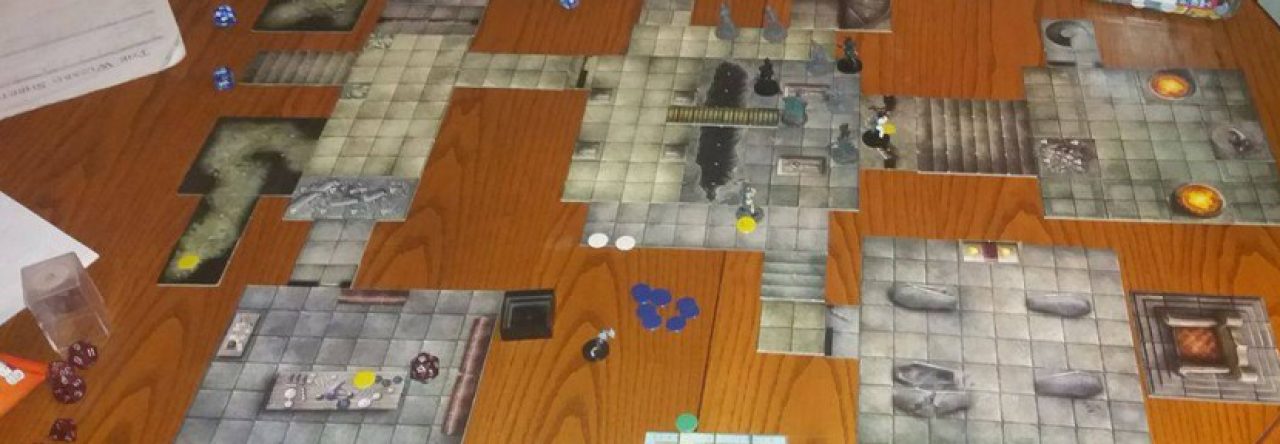
The third edition of Runebound hit stores in Decemeber last year. It is an adventure boardgame by Fantasy Flight Games and is very much marketed at the ‘Adventure-in-a-box’ style game. I think I should start by stating that I have never player any other edition of Runebound so I only have this one to go off. Whether that makes me ill-informed or more impartial is up to you. Straight away, as soon as the lid comes off the box you can sense the production value of the game, something that folks who know Fantasy Flight will be used to. The cards, the board and the miniatures are all beautiful. Though I’d like to just mention that Fantasy Flight have seemed to have switched from putting standard rulebooks in their games to two volumes; a ‘learn-to-play’ guide and a ‘rules reference’. I’m not sure what the reason for this was, I imagine it has something to do with making the rules easier to understand for a new player but I have found this new way of doing things (both in Runebound and other FFG titles) to be unintuitive. I find myself, or my friends, spend half the time asking which book the answer to an obscure rules question is in rather than playing. I’d be interested to hear other people’s views on this and if others have found this newer system more useful and why.
In Runebound each player assumes control of one of six characters and must travel the realm of Terrinoth collecting items and becoming more powerful. Each character is significantly different from the others and my only gripe is that there aren’t more of them. It’s a game that, in terms of appeal and atmosphere, is very similar to Talisman, for me at least. When you factor in that in a six player game you have no choice in who you play it feels worse than it probably should. I was expecting more characters and it’s a shame they’re a bit scarce. The board itself is divided into hexes and uses custom dice to determine how far a character may travel each turn by rolling a number of movement dice equal to the characters movement score and then allocating them as they see fit to terrain tiles on the board. This is where Runebound shines, and where for me it becomes praise worthy game. I enjoy the fact that the encounter decks are split into three different types; combat, exploration and social and it give me a real sense of adventure. Some of the encounters are very interesting, becoming a permanent fixture on the board and the fact that these draw decks are modified by the rules of the game’s scenario. We had one game where, as the vile dragonlord Margath was slowly building his power (the first of two scenarios that ship with the game) that a heretical cult of dragon worshippers set up shop in one of the outlying towns of Terrinoth. This changed how we played because anyone entering the town was subject to the cults wroth and as result we avoided the place like the plague.
Another element that I really enjoy about Runebound is the semi-co-operative elements to it (I have a serious love for anything that lets me quest with my friends). There is only one winner to the game, but to achieve that goal the player must work with others otherwise everyone loses. In the first scenario is ‘The Ascendance of Margath’ in which the aforementioned Margath the dragnlord is getting ready to slither out of his hiding place in the Mountains of Despair and attack the city of Tamalir. The game involved players getting ready for a final showdown when the dragon finally rears his ugly head. The second scenario is ‘The Corpse King’ which sees, in wonderfully western fantasy style, a necromancer king raising an army of zombies and preparing to kill everyone and turn them into his undead slaves. In both scenarios the game can ‘win’ either by the players letting Margath reach the capital or by letting Vorakesh the corpse king overrun the world with his undead minions. I will try to refrain from comparing Runebound to Talisman but I can’t really help it , and an example of where Runebound does something far better than the latter is that is has a definitive end point. Each round a counter goes down till either the players have stopped the big bad guy or have died trying. It stops the possible meaningless stalemate that Talisman often devolves into. It also punishes you less. Runebound is less about random chance; I really feel as though I can explore where I want and if I run out of health while doing so I can slowly recover it, rather than having to pick a different character out of the box and start over. The game in general is extremely well balanced and really scratches that adventurous vibe. At times it feels almost like a single player game because none of the characters, bar one, can directly attack the others. This means that the competitive element becomes a race to the best quests, items and shops over out and out murder of each other. I find it a very relaxing game to play, one where I can do things at my own pace and don’t feel under pressure to out manoeuvre my friends and kill them, which is a nice thing. Sometimes.

My single biggest complaint with the game is the combat system. It’s convoluted and open to exploitation. Basically the player and the monster, controlled by another player toss coin-like disks that have different abilities on each side. This creates a pool of actions that can be spent by the player and the monster; some of the sides deal damage, some block, some dodge and others have more interesting effects. Weapons and other items often add unique disks to a players’ pool for fighting. On the surface, I really like it as it is a unique way of doing a fight that keeps the player involved at a level higher than just rolling dice. However, as the opposing player must choose how to assign the monsters tokens, there is the option of playing the monsters intentionally bad. The rulebook does address this and say that you shouldn’t do it, but in practice it’s very hard to police. Doubly so when the book also suggests other players take their turn while the fight plays out. No one to make sure that Margath the terrible isn’t saving his blocks for the enemy’s weakest attack, or attacking when the defending player has a pool of shield dice could easily become a problem. It’s not too bad, if you have a group of players that are really into their boardgames and want to play it right, but it means the game is not a good one to crack out with a large group of friends on a beer and pretzel night.
Overall I think that the game is well designed and the level of quality that has gone into the production of the components is commendable. The game very much evokes it’s own unique feel of adventure and gives people a balanced, coherent, adventure experience that can be played in an hour and a half or so. However, the game does fall down some of the details that can make the experience feel a bit sterile at times, like the fact the terrain dice are used for everything and that the combat system needs work. I would say in conclusion however that the game is fairly solid and definitely worth the price that FFG have it retailing for, especially if you enjoy being ableto quest like I do, in an afternoon, on your kitchen table.
Based on the following criteria; rules, presentation, ease of play, cost, and support I would give Runebound:
3 out of 5
The game has a good atmosphere and is not difficult to learn nor is overly aggressive, though it has a few possible balancing issues that may emerge as a result of the combat system.
 Vault of the Geek